













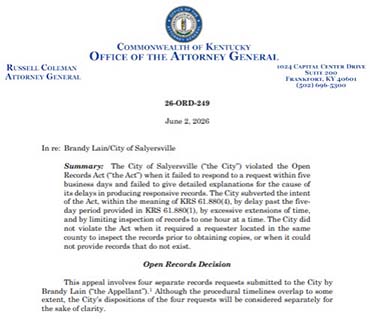
FRANKFORT – Kentucky Attorney General Russell Coleman’s office released an Open Records decision against the City of Salyersville on Tuesday, ruling that the City had violated the Open Records Act in regards to recent Open Records Requests made by a city council candidate.
Brandy Lain, who has been vocal about transparency, mismanagement and oversight in recent city council meetings and is now running as a candidate in the city council race, filed an appeal against the City of Salyersville to the Attorney General’s office regarding Open Records Requests responses from earlier this year.
According to the AG’s decision released this week, on January 29 this year, Lain had requested copies of Salyersville Water Works records from the last five years pertaining to logs of line leaks or breaks; water loss reports; correspondence that referred to water leaks, infrastructure failures or unplanned outages; and “plans or reports submitted to funders or oversight entities describing infrastructure condition and replacement schedules.” The City reportedly responded, citing KRS 61.872(5), “Due to the volume of records requested, the multi-year time span involved, and the fact that responsive records are maintained by multiple City departments and custodians, the requested records are not immediately available for inspection and copying. Additionally, the City is currently responding to a significant number of pending Open Records requests with limited administrative staff.” The City stated it would “be able to issue a substantive response and/or make records available for inspection on or before February 23, 2026.”
According to the AG’s report, the City issued a final response on February 23 that the records had “been identified and compiled” and would “be made available for inspection during regular business hours at City Hall.” Lain responded on March 3, stating she did not believe her request had “been fulfilled in entirety,” asking the City to send copies of the records, which the City responded the next day, basically just reiterating the first response, and that copies could be obtained upon request at the statutory rate of $0.10 per page, at which point Lain filed an appeal.
State law requires a public agency must decide within five business days whether to grant a request or deny it. The five days may be extended only when records are “in active use, in storage or not otherwise available,” and only if the agency gives a “detailed explanation of the cause” for the delay and gives a place, time and earliest date the records will be available. Past rulings dictate that public offices cannot delay a response due to the volume of the request or due to staffing issues.
The AG ruled that the City of Salyersville failed to provide a “detailed explanation” required by law in that instance.
Also included in the decision, it states that “a person who ‘feels the intent of [the Act] is being subverted by an agency short of denial of inspection, including but not limited to…delay past the five-day period described in’ KRS 61.880(1), may appeal to the Attorney General as if the record had been denied.” As part of Lain’s appeal, she claimed that the City had subverted the intent of the Open Records Act by an unreasonable delay in producing records. Since the burden of proof is on the City to explain the reason for the delay, and they did not include any information about the number of records implicated by the request, the location of the records, or any issues posed by the content of the records, the AG ruled that the City had subverted the intent of the intent of the Open Records Act.
Lain has also claimed the City had violated the law by only making the records available for inspection, not sending her copies as requested, however, the law dictates that only “a person whose residence or principal place of business is outside the county in which the public records are located’ has the right to receive copies without first having inspected the records in person.” Since nothing in the records from the request and subsequent appeal indicated Lain lives or works outside of Magoffin, the AG ruled the City did not violate the Open Records Act by not sending copies of the requested records prior to inspection.
In a second Open Records Request from February 26, 2026, Lain submitted a new request identical to the January 29 request. The City responded, again, that the records were available for inspection, but would only “be available by appoint in one-hour sessions,” citing “staffing limitations and ongoing municipal operations.” The AG ruled that response did subvert the intent of the Act, short of denial of inspection, by imposing such restrictions without any legal justifications.
On March 2, Lain requested records relating to water service at her own residence regarding meter readings and water loss reports, to which the City responded that “[b]ecause responsive records must be retrieved from the Water Works system and reviewed prior to production, additional time is necessary to complete this process,” stating the records would be provided by March 17. Since their response did not give a detailed explanation of the cause of the delay, the AG, again, ruled the City violated the Act by not granting timely access to those records.
On March 17, the City notified Lain the records were available and she provided some suggested dates and time for inspection, but the City determined the records were not as numerous as anticipated and subsequently provided some of the records by email on March 19. The City reportedly stated “the most recent annual water loss report [was] not included” and would be provided to the Appellant by March 24, 2026, but did not explain the reason for the delay in that report. By imposing a further, unexplained delay, the AG ruled the City subverted the intent of the Act within the meaning of KRS 61.880(4), yet, again.
In the March 19 response from the City, the City stated some of the requested records do not exist, which then shifts the burden to the requester to show the records either do or should exist. Since Lain was unable to show any evidence the records were required to be maintained, the AG ruled the City did not violate the Act in that situation.
The fourth request in question for the appeal was submitted on March 4, and was a “multi-part request for various ‘records relating to utility billing practices, meter readings, system reconciliation, and financial transfers involving Salyersville Water Works’ from January 1, 2023, to the date of the request.” The City reportedly did not respond to this request before March 19, when it told Lain the records were available for inspection. The AG ruled that the City violated the Act by failing to respond to the request within five business days, as required by the law.
If you’re keeping score, of the eight claims made against the City in Lain’s appeal, the AG ruled against the City in six separate instances, ruling in favor of the City only twice.
Either party, the City or Lain, can appeal the decision by initiating an action through the circuit court within 30 days from the June 2 decision.