











SALYERSVILLE – After continuous criticism as of late of the mayor’s and council’s implementation of a three-minute time limit for public comments at city council meetings, as well as the mayor’s handling the failing sewer system and struggling water department, a decision by the mayor was placed on the agenda for Monday’s meeting to forbid public comments in the meeting did not sit well with some.
Former Salyersville Water Works Superintendent David Gardner addressed the council prior to the meeting, stating, “The meeting starts at 7:30, and even though I don’t agree with what the mayor has been on there as far as no public comment, the meeting has not been called to order, so I can speak if I can hold the room.”
Gardner briefly explained that he and Jeff Lovely, the city attorney, had been arguing back and forth about who gets to control whether there are public comments, with Gardner stating he believes the council ultimately controls it.
“Basically, the argument with Jeff and I is if the council hasn’t acted, then the mayor does control the agenda,” Gardner said. “Well, that is true, and I have been corrected on that by Jeff. I’m asking the council, if you look at the agenda, you know they mayor has put on there, ‘no public comments.’ I know if the council votes one way or the other, then I ask a public will accept that. I think it is important that the council makes the decision. I think it’s important that the council says to the people of Salyersville, either you’re welcome to make public comments or you’re not welcome to make public comments. I think it’s important the council says to the public that, ‘We control the agenda. We control the meetings. We control what happens in Salyersville.’”
At that, Mayor Stanley Howard called the meeting to order, ending Gardner’s pleas to the council.
Checking in with representatives in Frankfort, Mortimer Media confirmed that a city council member can add items to the agenda if there are ordinances established in city government indicate that is available to them. Otherwise, there are some other options, including if there is an item on the agenda for “new business,” any council person can bring up any new subject or discuss it thereafter. Also, after an agenda is complete, a council person has the right to bring up an item to discuss.
As for the limitation of public comments, Kentucky law does state that the public has the right to attend open meetings, however, the Open Meetings Act does not require a public agency to permit public comments or public participation.
The mayor defended his decision to not allow public comment during the April 20 meeting, stating there was a lot of business to cover.
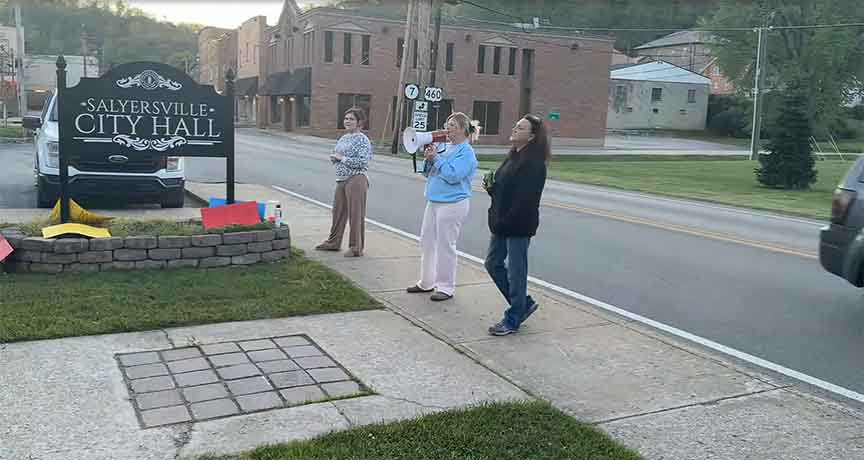
Meanwhile, outside city hall a very loud three – and at one point four – protestors in disagreement with the decision to not allow public comment, could be heard throughout the meeting.
“What inspired to was the fact I feel like there should be no restrictions on public comment in a meeting that they discuss projects or making any decisions that affect our community without the community having the option and a choice to come in, ask questions, or have a comment,” Amber Risner, one of the protestors told Mortimer Media Group. “I just feel like that should just be – I don’t believe in a restriction like that, even though they go about it in a legal way, I just don’t think it’s right. There were some questions I had about some funding that had come in for some roads in the city limits, one of which the mayor resides on with several of his rental property. I would like clarification on if it is a city/county road, and it could be. I don’t know. I feel like if I have a question and if that’s on the agenda, and ask that for clarification. You know, $16,000 is quite a bit to drop and I think that if you are concerned, you should be able to express that inside of the public meeting.”